Case Study
Envisioning Airport Customer Service
In partnership with United Airlines to address strategic business goals, this project delved into the future role and tools of customer service representatives (CSRs). As UX Researcher and Lead Product Designer on the project, I provided generative and evaluative insights as well as a systems-level lens to the development of Air Agent – a three-touchpoint enterprise system that allows CSRs to parse complex air travel policies and bring personalized assistance to customers anywhere in the lobby, by leveraging artificial intelligence and augmented reality.
- My Role
- Researcher and Designer
- Deliverables
- Insights report, design artifacts, design systems, service blueprint
- Timeline
- Apr 2024 – Aug 2024
Project Context
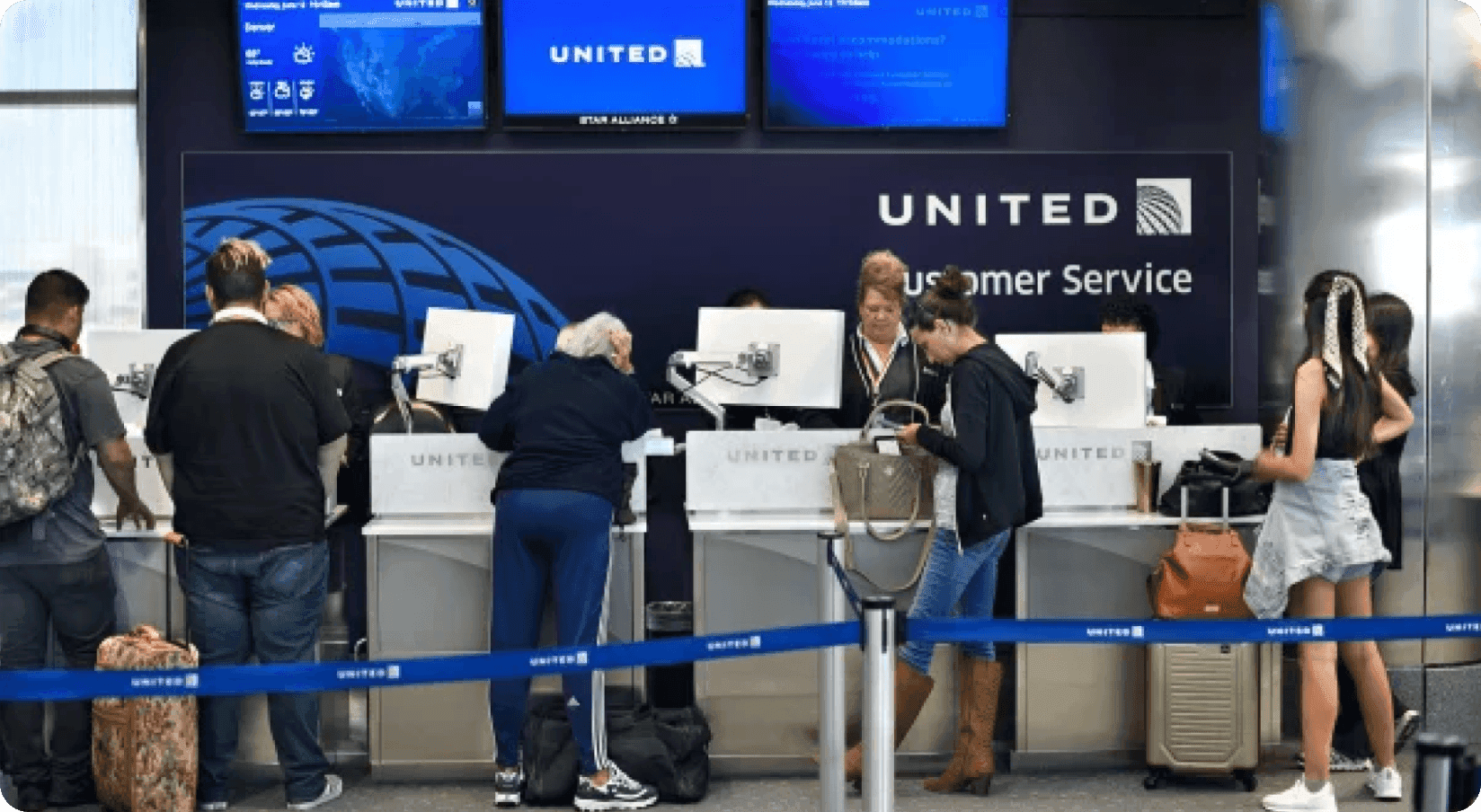
In partnership with United Airlines, our team studied the experience of Customer Service Representatives (CSRs) at Seattle-Tacoma International Airport (SEA) and Chicago O'Hare International Airport's lobbies (ORD), and explore next-generation internal tools that could aid them in their work.
Enhancing employee tools was one of the client's strategic pillars for growth. Our team chose to support this pillar for our Capstone Project as we saw huge potential for interventions in this space to impact employee, customer, and business outcomes:
- For 17,000 CSRs — Enterprise tools used by employees have not been elevated to the same standards as customer-facing tools.
- For 165 million customers — As the first point of contact for passengers arriving at the airport, the experience of CSRs are intricately tied to customer experiences.
- For the business — Interventions in this space would support the airline's strategic pillars, and differentiate it from competitors.
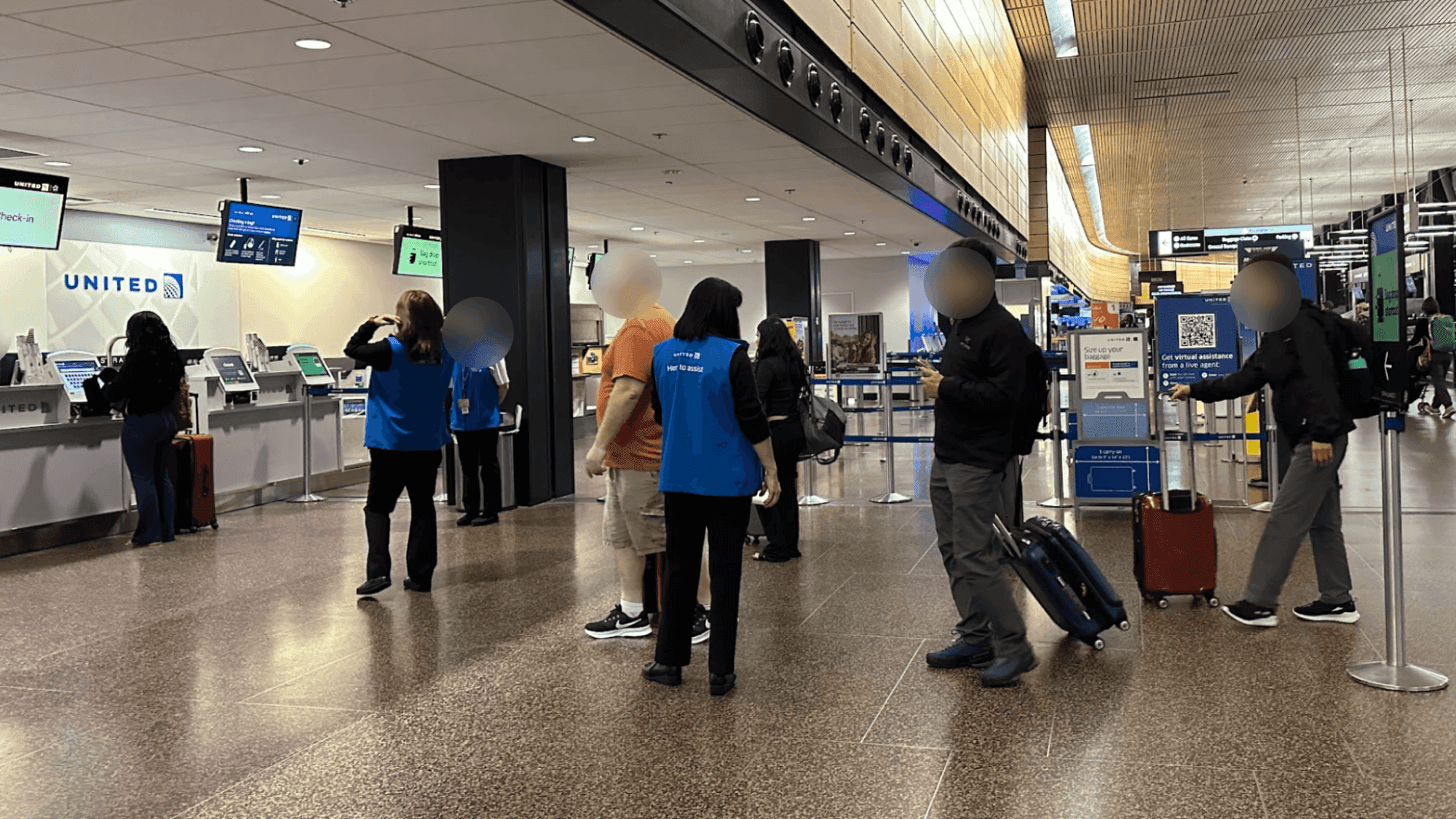 A customer service representative ushering travellers to kiosks.
My Role
As the Lead UX Researcher on the project, I highlighted an overlooked element in the client's customer experience strategy – the ambiguous role of the CSR in an era of self-service travel.
By clarifying essential customer-CSR interactions, I secured leadership buy-in on the team's re-envisioned internal tool system and its potential to improve not only employee satisfaction but customer outcomes.
I achieved this by:
- Overseeing research design, fieldwork, synthesis and reporting throughout the project.
- Facilitating jobs-to-be-done and ideation workshops, and leading agile/scrum rituals
- Mapping our intervention at the system-level.
Methods & Frameworks
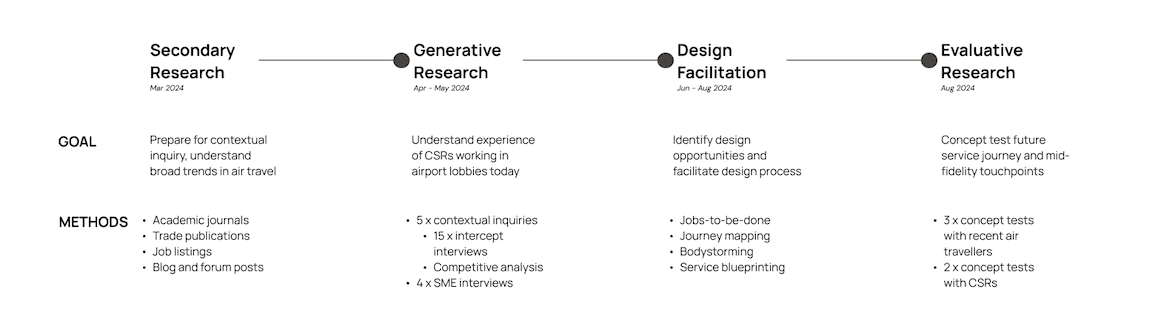
Generative Research
As a CSR's work is highly contextual, we needed to observe their interactions with customers in-situ to truly understand their workflow. I led the team in conducting contextual inquiries as our primary method of research.
We complemented the contextual inquiries with in-depth interviews with station management and tenured CSRs (>30 years of experience each) to gain a bird's-eye-view of protocols, change management, and KPIs.
Research Questions:
- What is the current experience of a United Airlines CSR at SeaTac?
- Key responsibilities, tasks, and capabilities
- Obstacles when assisting customers
- Resources available to address customer needs
View full research plan below:
Main Takeaway: Customers now engage with various self-service options to different degrees, creating a more complex and fluid passenger flow compared to traditional queuing systems.
This made CSRs' work more ambiguous and challenging as a result. They now need to:
- Monitor a larger lobby area for customers who look like they need help
- Diagnose individual customer needs and provide assistance next to the kiosk and away from their desk terminals
- Otherwise maintain a hands-off approach and not hand-hold the customer through check-in processes
The push for self-service and automation also reduced opportunities for building personal rapport with customers, highlighting a tension between empathy and efficiency.
"So why are we talking about customer service if you're just going to be able to do it by yourself one day? If you take care of your customers… they'll get to keep coming back forever, you know?" – A tenured CSR we spoke to with over 30 years of experience
View generative research report below:
Design Facilitation
Key workshops and frameworks we utilized:
- Jobs-to-be-done – sort through myriad of tasks that CSRs tackle to identify key motivations
- Step-jump-leap – categorize our ideas into different future horizons to find a balance between innovation and business constraints
- Storyboarding & bodystorming – refine key moments and interactions in the service journey
- Service blueprint – mapped out entire service journey from frontend interactions to backend systems
Evaluative Research
We had just 3 weeks to execute on our design, but we all felt that concept testing was necessary, especially since we were missing the customer perspective. In 5 days, I planned, recruited, moderated and analyzed 5 concept tests, gathering critical insights that informed our final designs.
We initially planned to conduct rapid iterative testing and evaluation with the ground team at SEA, as a way to close the loop on our generative research outcomes and to ensure that their feedback were taken in before we presented our designs to the client. However, our planned dates coincided with the Crowdstrike outage. Considering that the team may be overwhelmed by the ensuing service recovery, we pivoted to concept testing and other sources of feedback.
Research Questions:
- What touchpoints of the prototype resonate / don't resonate with participants?
- What do they think of the key customer journey?
- Overall, do CSRs feel that the proposed prototype can support them to deliver timely and personalized assistance to customers?
- Overall, do customers feel that the proposed prototype improve their airport experience?
User Testing & Refinement
One of the concept tests I moderatedUsing a storyboard walkthrough with mid-fidelity screen mock-ups, we gathered feedback from 3 recent air travellers (personal contacts) and 2 CSRs (recruited through direct LinkedIn messages), and made updates to our final designs.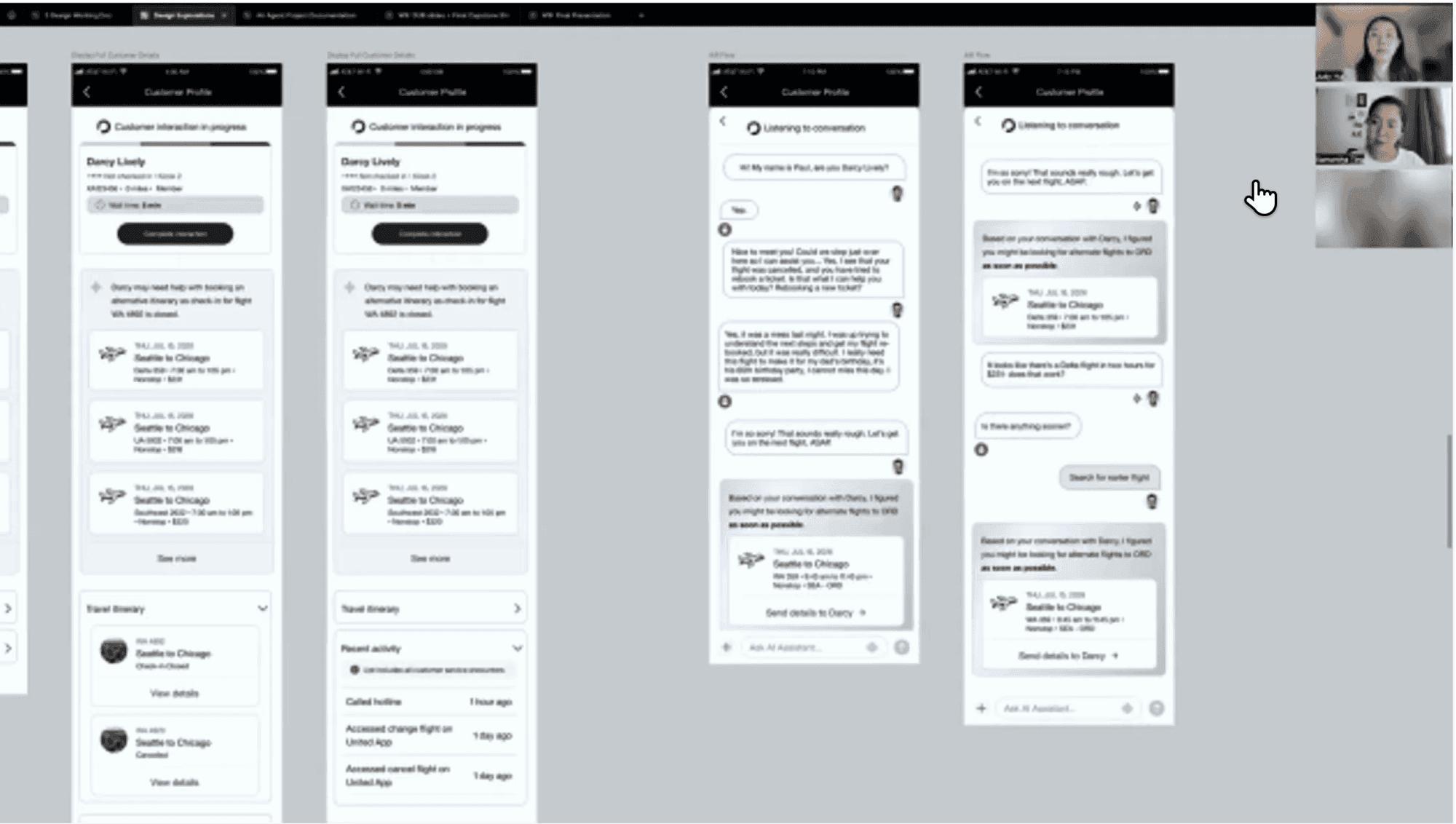
Updates to the final design:
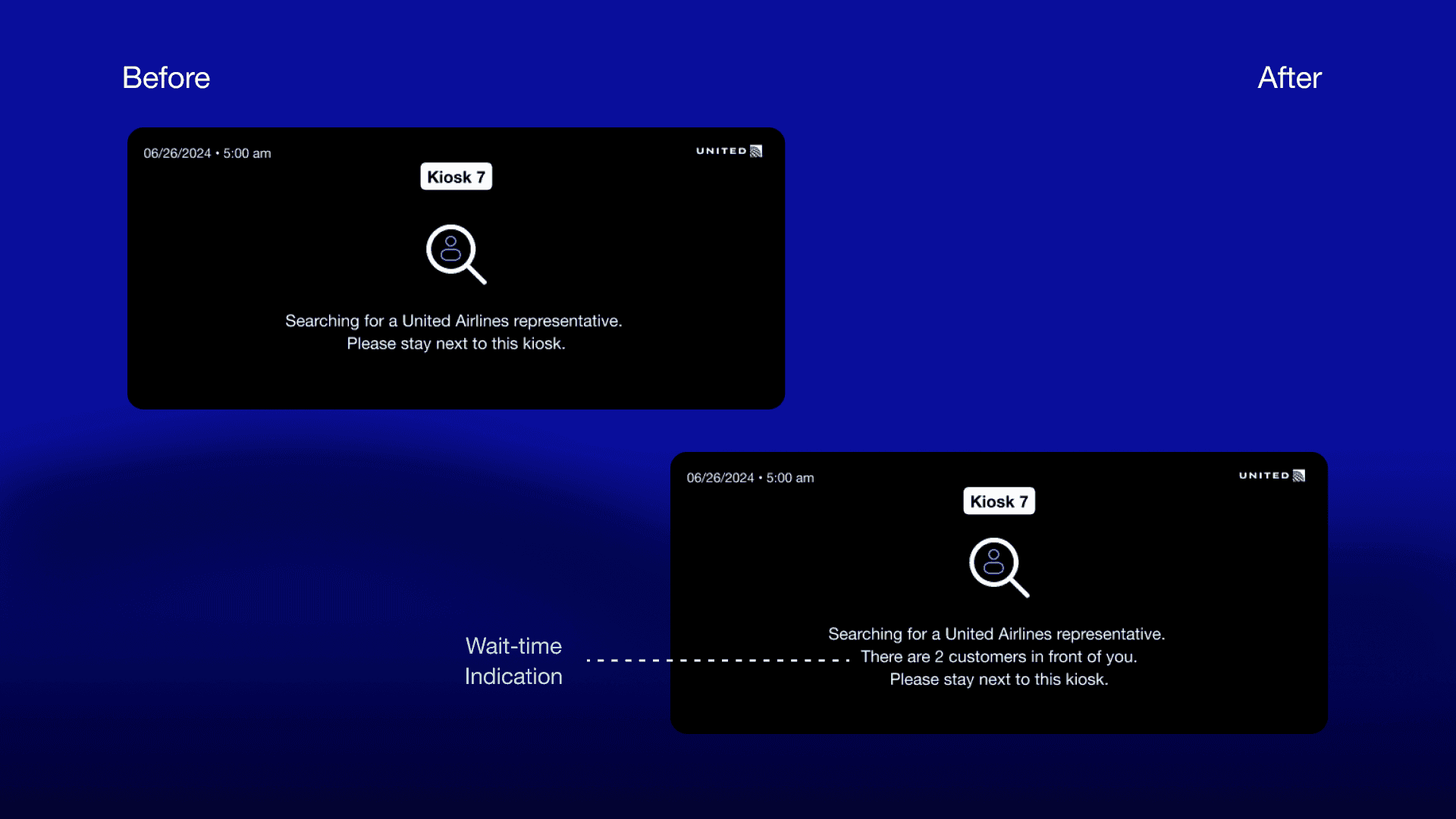
01Explicit consent for audio inputPivoted from a line of text to inform the customer of the use of audio input to an explicit checkbox for consent, after the customer requests for assistance.02Masked personal contact infoMasked the customer's personal contact information when CSRs send resources and confirmation details to the customer.03Position-in-line indicationAdded a position-in-line indication on the kiosk screen and customer-facing app screen to manage wait time expectations.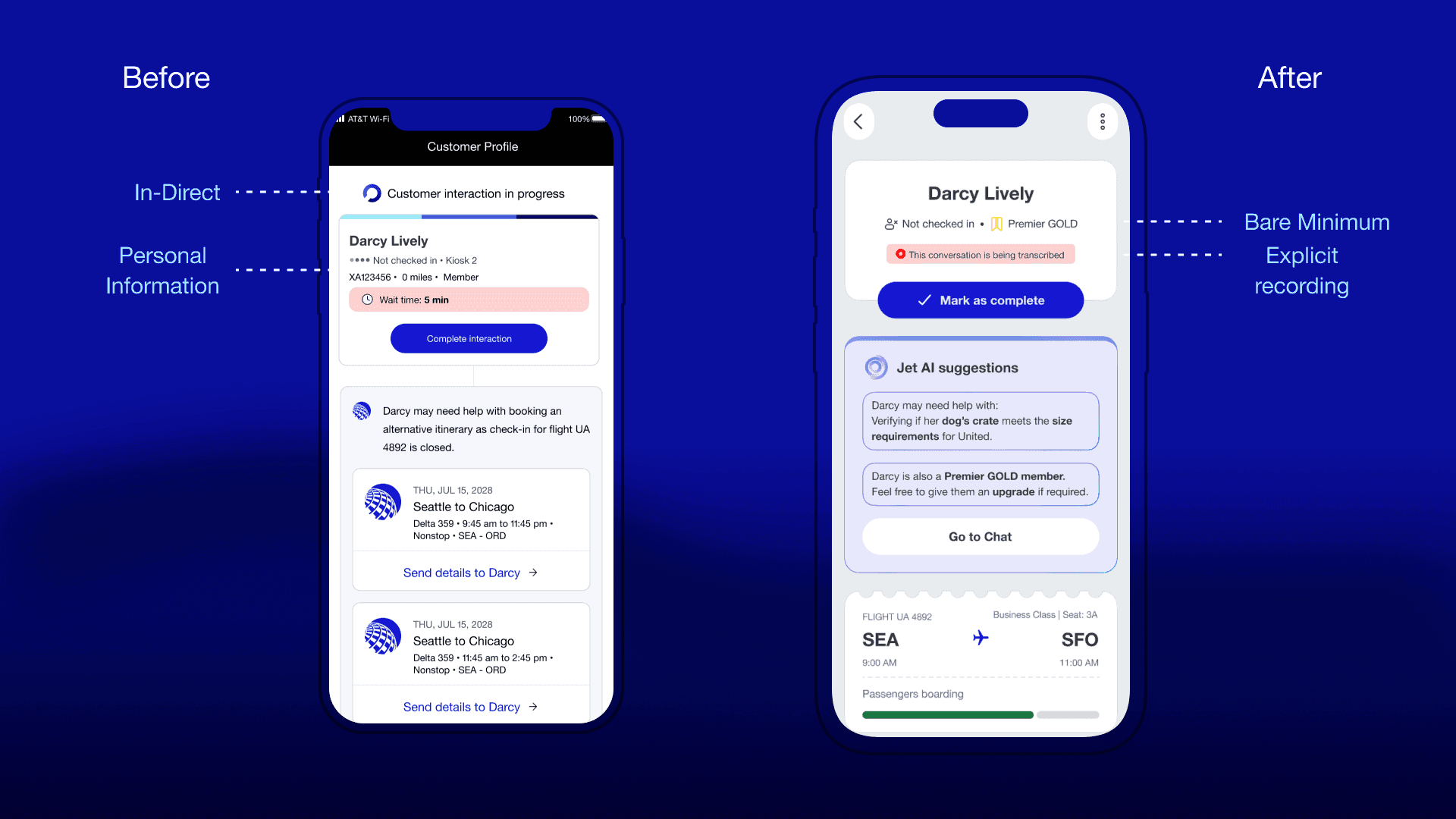
Click here to view the design solution that came out of this research →