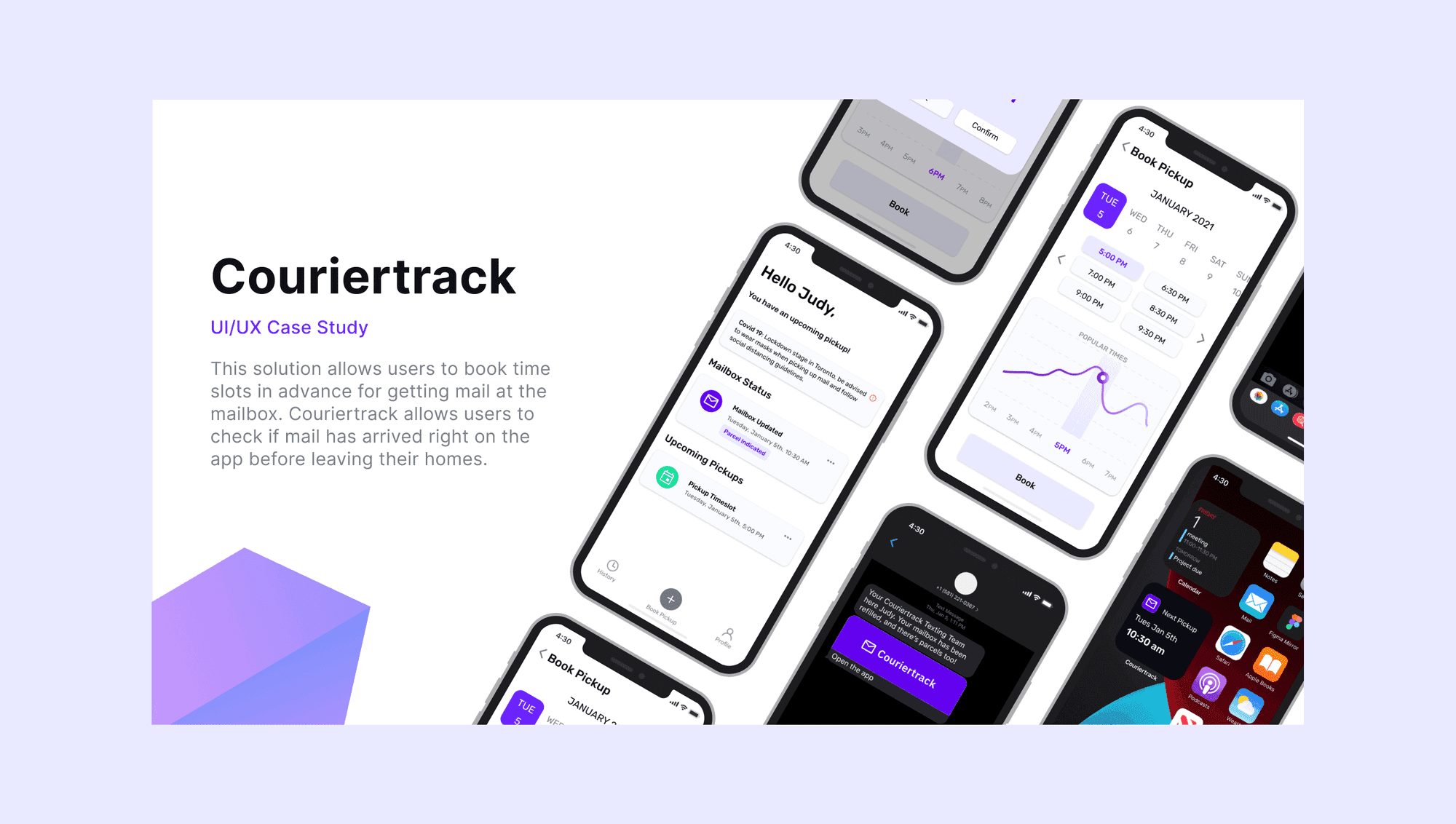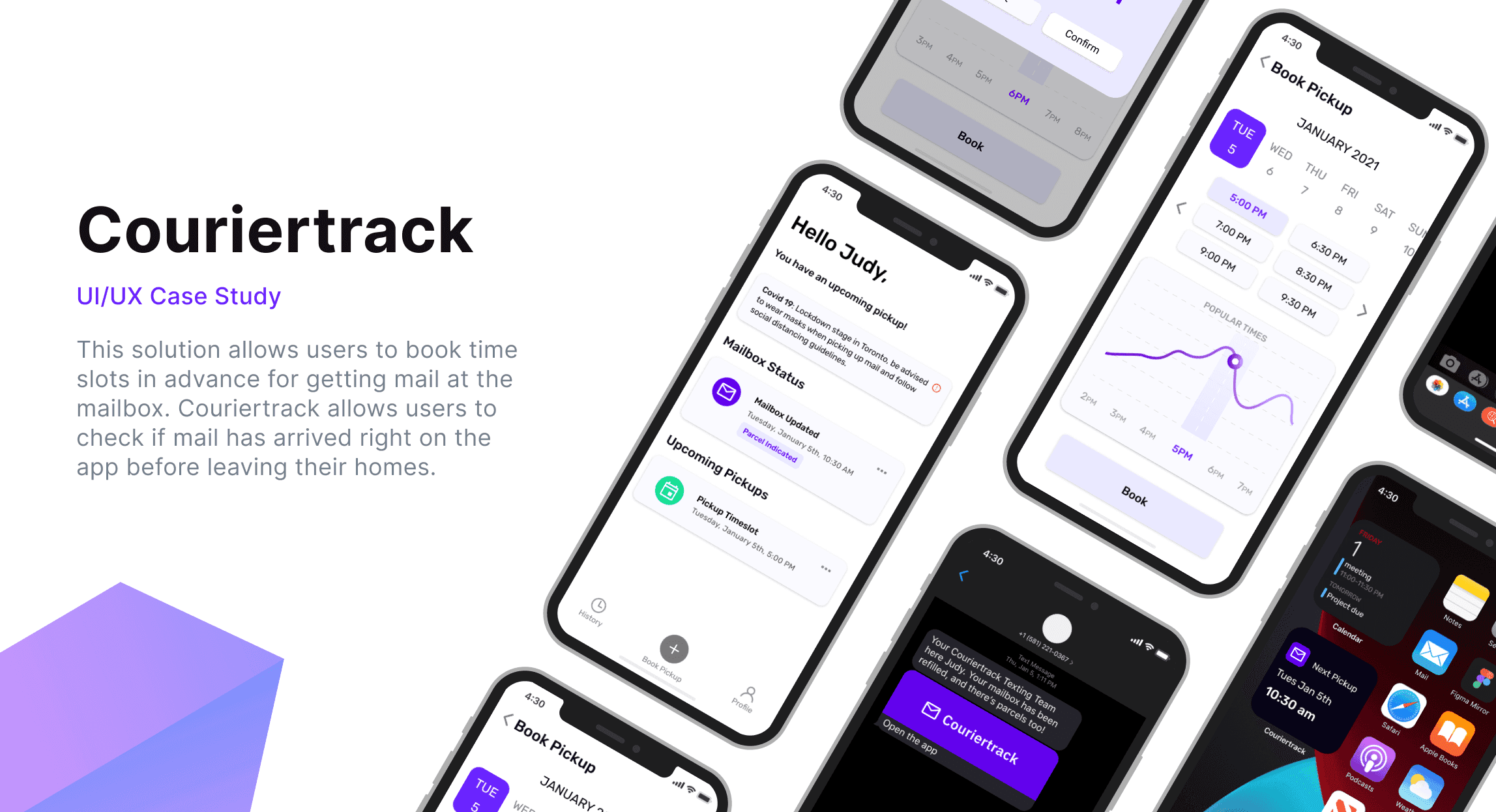
Case Study
Couriertrack — Mail Appointment Booker
A solo course project that observed an everyday non-digital experience and designed an experiential improvement: a mobile app to book mailbox pickup time-slots and reduce community-park crowding during the pandemic.
- My Role
- User Research, Data Visualization, Wire-framing, Prototyping, UX Design
- Timeline
- Sep – Dec 2020
- Tools
- Figma, Mural
The Brief
Observe people's interaction with an everyday experience that isn't primarily digital or based at home. Based on the findings from the observations, suggest an experiential improvement that augments or enhances a user's goals and objectives.
Couriertrack was designed as an individual course project at Sheridan College — end-to-end research and design.
Process
I led the project through three phases, each anchored to a distinct deliverable.
01Experience DesignResearch, synthesizing data, user persona, journey map, solution ideation.02Information DesignData visualization, secondary research, stakeholders, ERAF systems framework.03Interface DesignDesign requirements, sketches, wire-framing, style tile, iterations, prototyping.Observation Insights
Observations were taken from a community park bench, carefully noting both the external elements and signals of the primary experience.
Insight 01 — Mailbox trafficMailboxes were the highest-trafficked areas in the park vicinity.Insight 02 — Mask usageOut of 65 individuals observed, no one wore a face mask or covering.Data Visualization
Party Size
Hypothesis: The busier the time of day, the more likely it is for people to travel in groups. Independent variable: The three observation sessions. Dependent variable: The number of people observed. The quantitative data suggests that visitors to the park or its vicinity often travelled in parties of two or more — and groups carry a higher risk of spreading to others and amongst themselves.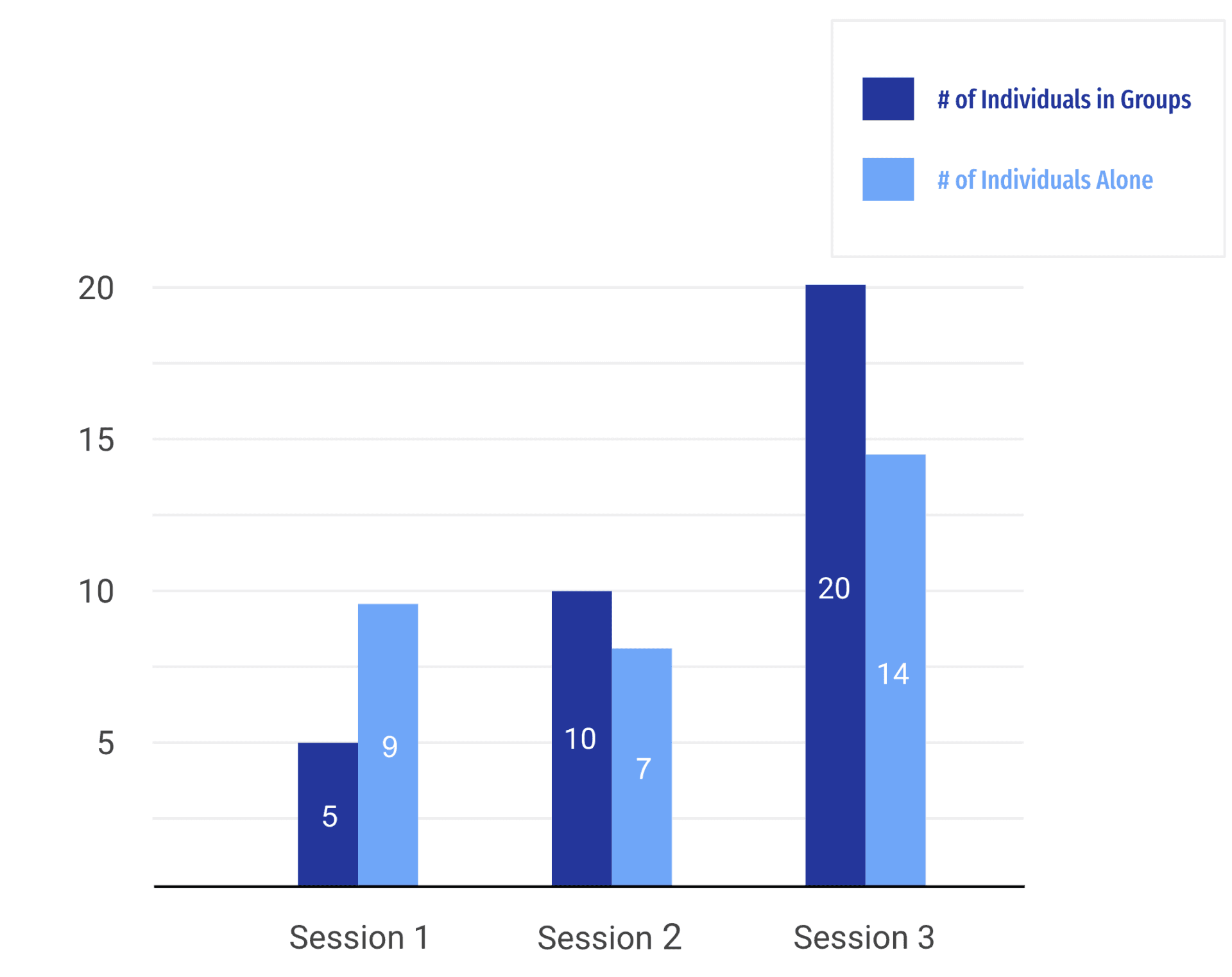
Mailbox Duration
Hypothesis: The busier the session, the more people in the mailbox vicinity. Independent variable: The minutes into the session. Dependent variable: The number of people crossing or using the mailbox. The mailbox area had 37 users crossing or using it across three sessions. As the graph shows, it's seldom empty — high traffic exposes individuals to more close-proximity contact and elevates transmission risk.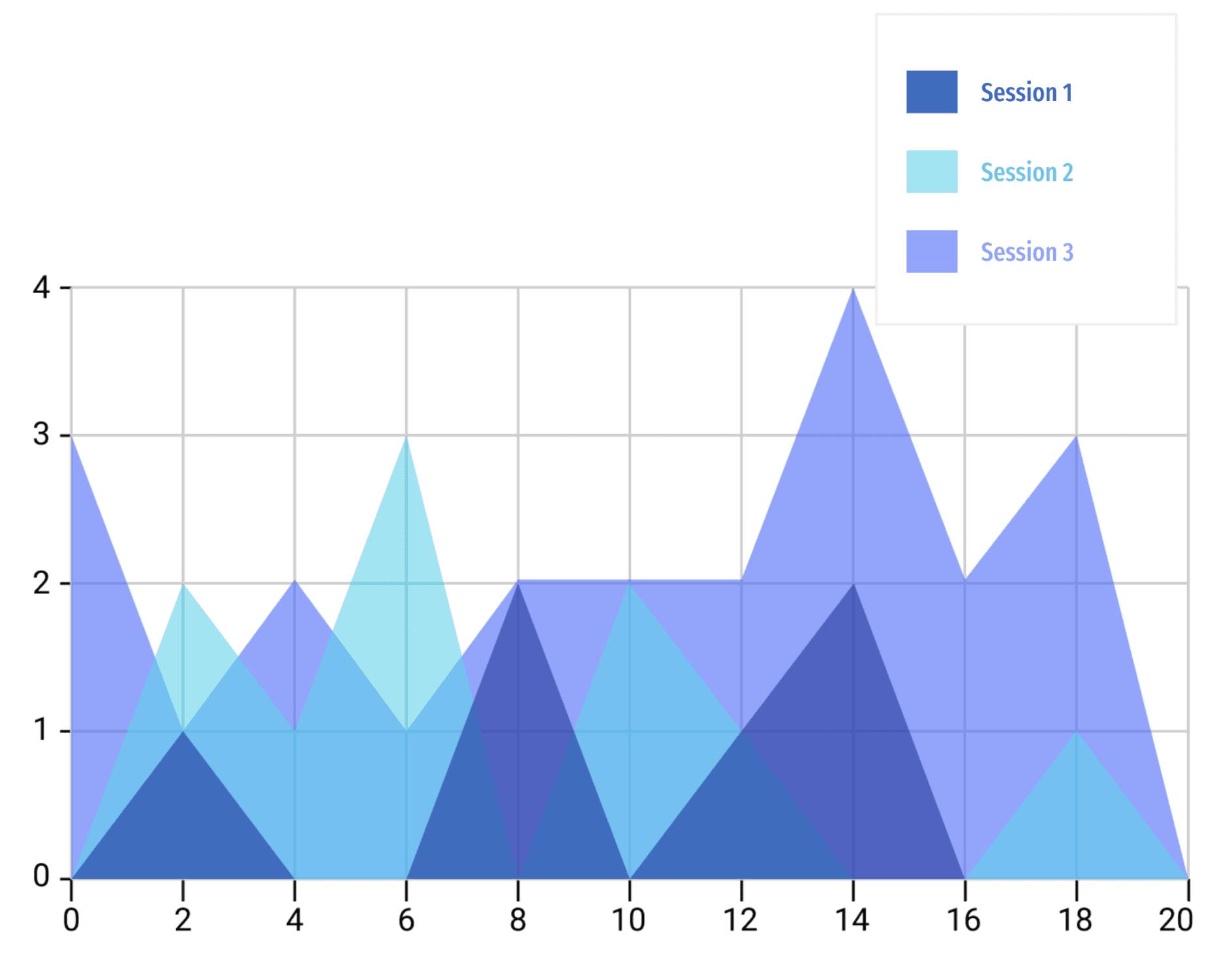
Household Size
Hypothesis: Households in Markham Ward 5 are likely to house more than 4 individuals. Independent variable: Households in Markham Ward 5. Dependent variable: Proportional households per tier relative to the total. From the demographics fact sheet: 96.5% of people live in households with more than 1 resident, and 63% live in households of 4 or more — the bracket with the greatest transmission risk.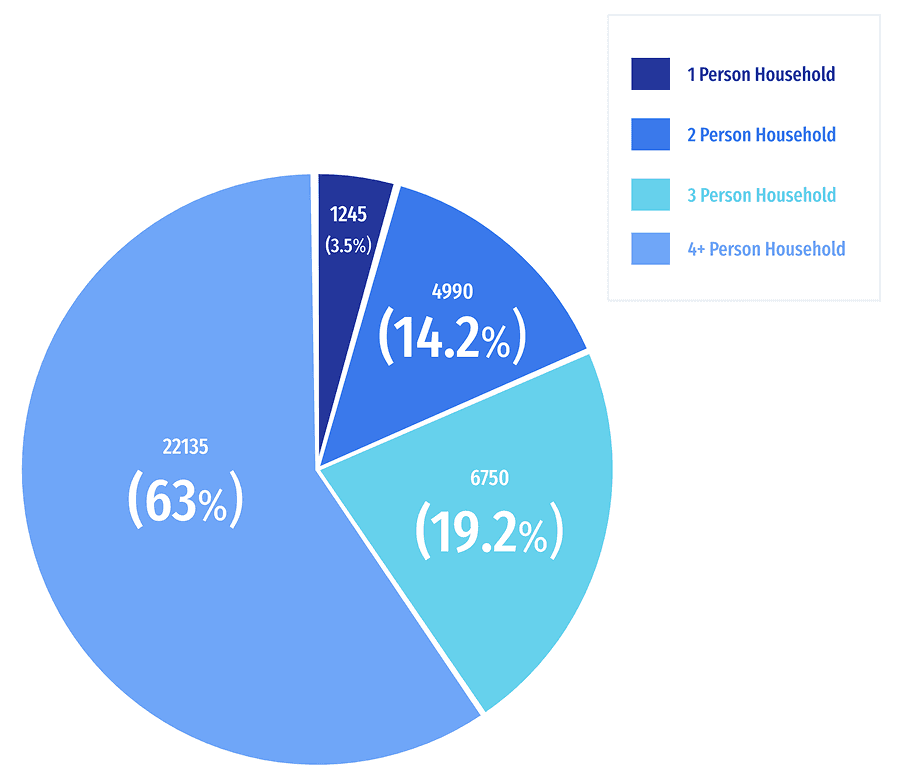
The Problem
The data points to a compounding risk near the mailbox vicinity:
People often travelled in groups.The high-traffic mailbox area exposes individuals to close proximity with no masks.Most people live in households of 4 or more — the bracket at greatest risk of transmission.ERAF Systems
The ERAF systems framework helped me map the relationships and flows between entities, weighted by exposure risk during the pandemic.
PRE-INTERVENTIONThe first ERAF shows the ecosystem of the community park before the intervention. Three large flows (orange arrows) represent people exposing themselves to others.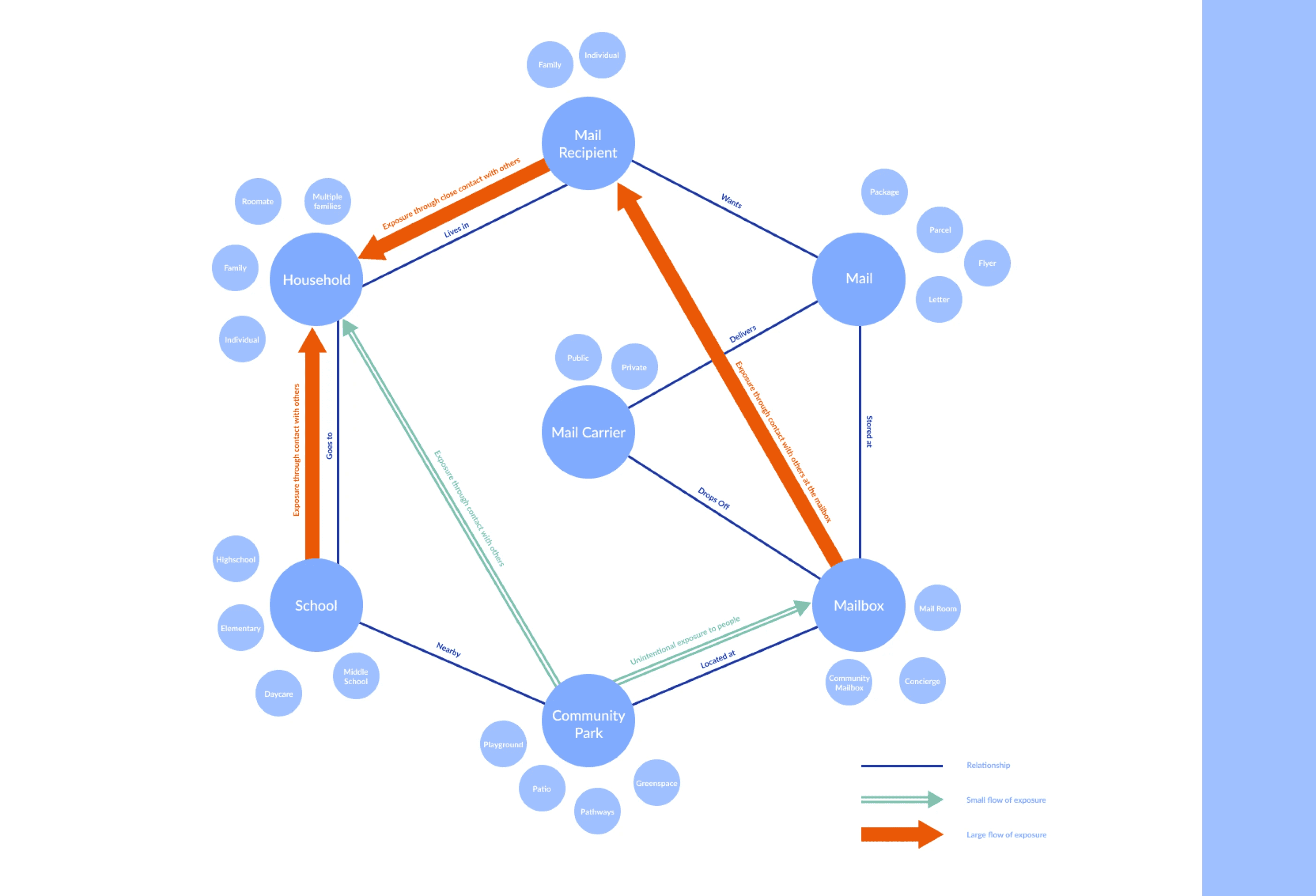 POST-INTERVENTIONThe second ERAF shows the ecosystem after the intervention. One major flow of exposure has been minimized — mail recipients now pick up mail during their booked time slot, reducing close-contact density.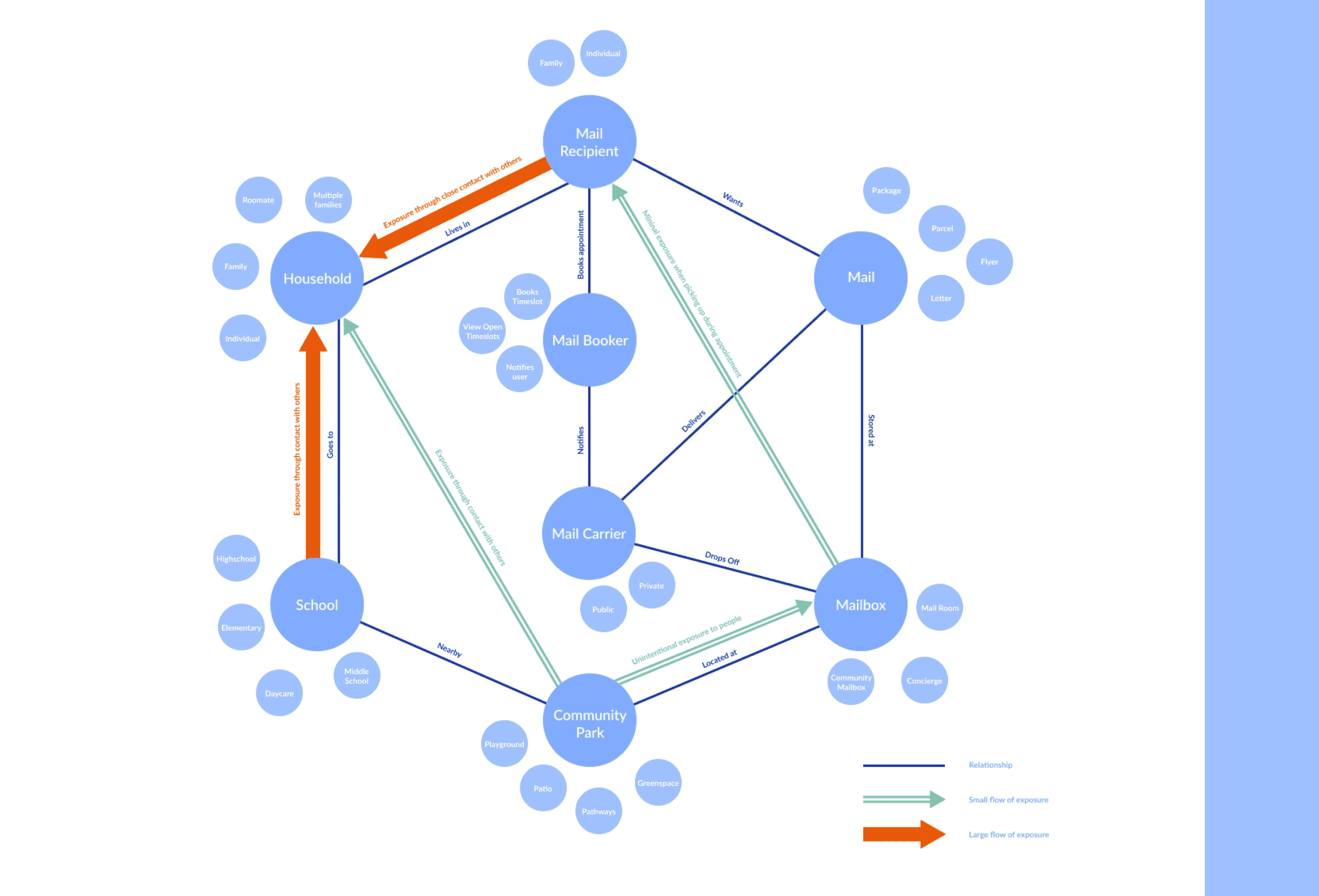
Design Solution
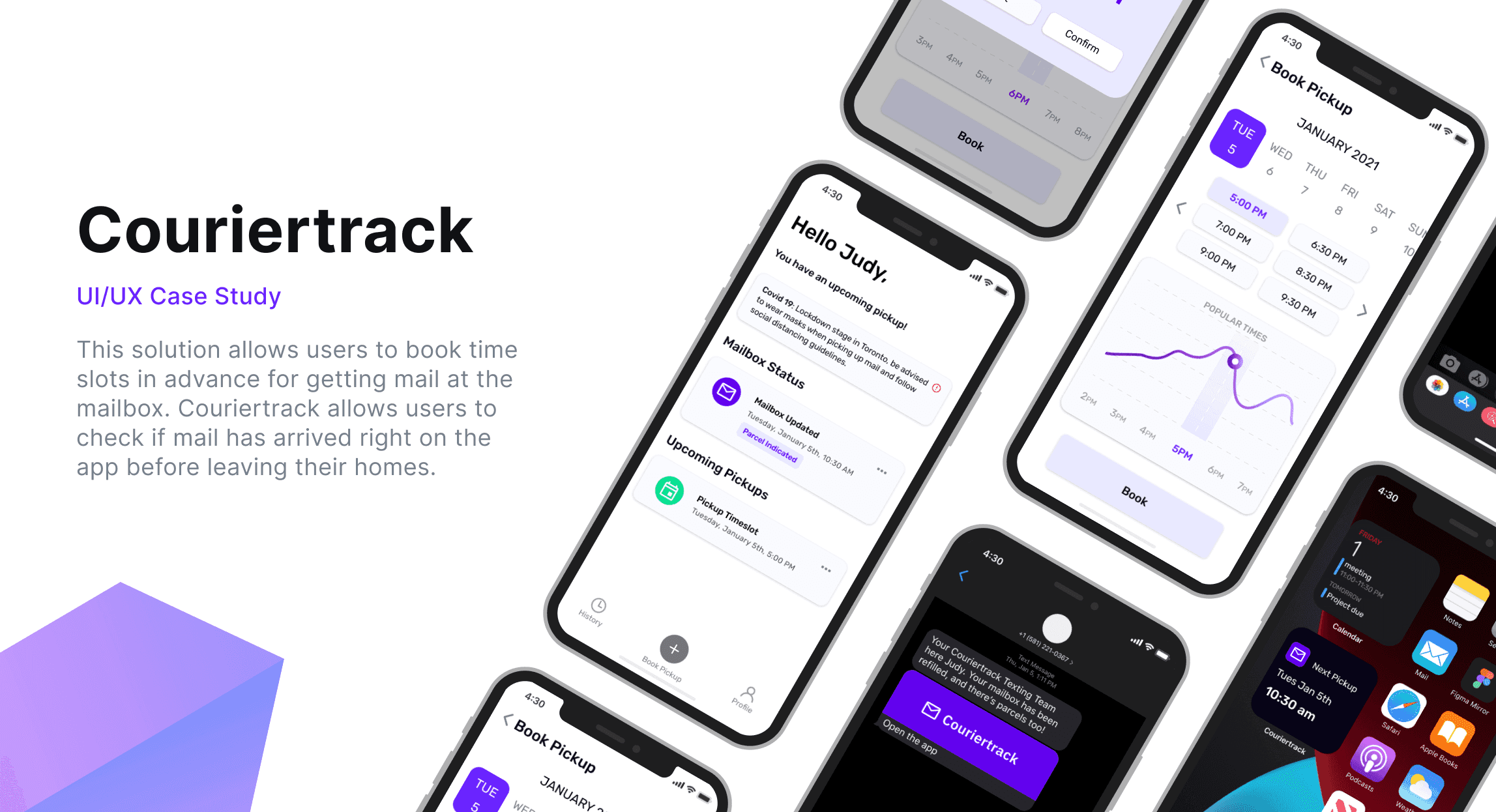
Couriertrack lets users book time-slots in advance for picking up mail. The app determines designated mailbox and package pick-up locations, surfaces foot-traffic information, and lets users check whether mail has arrived before leaving home.
Interface Design
Design Requirement
The design requirement converts my persona's wants and needs into engineering requirements — informing the wireframes and content flow for the intervention.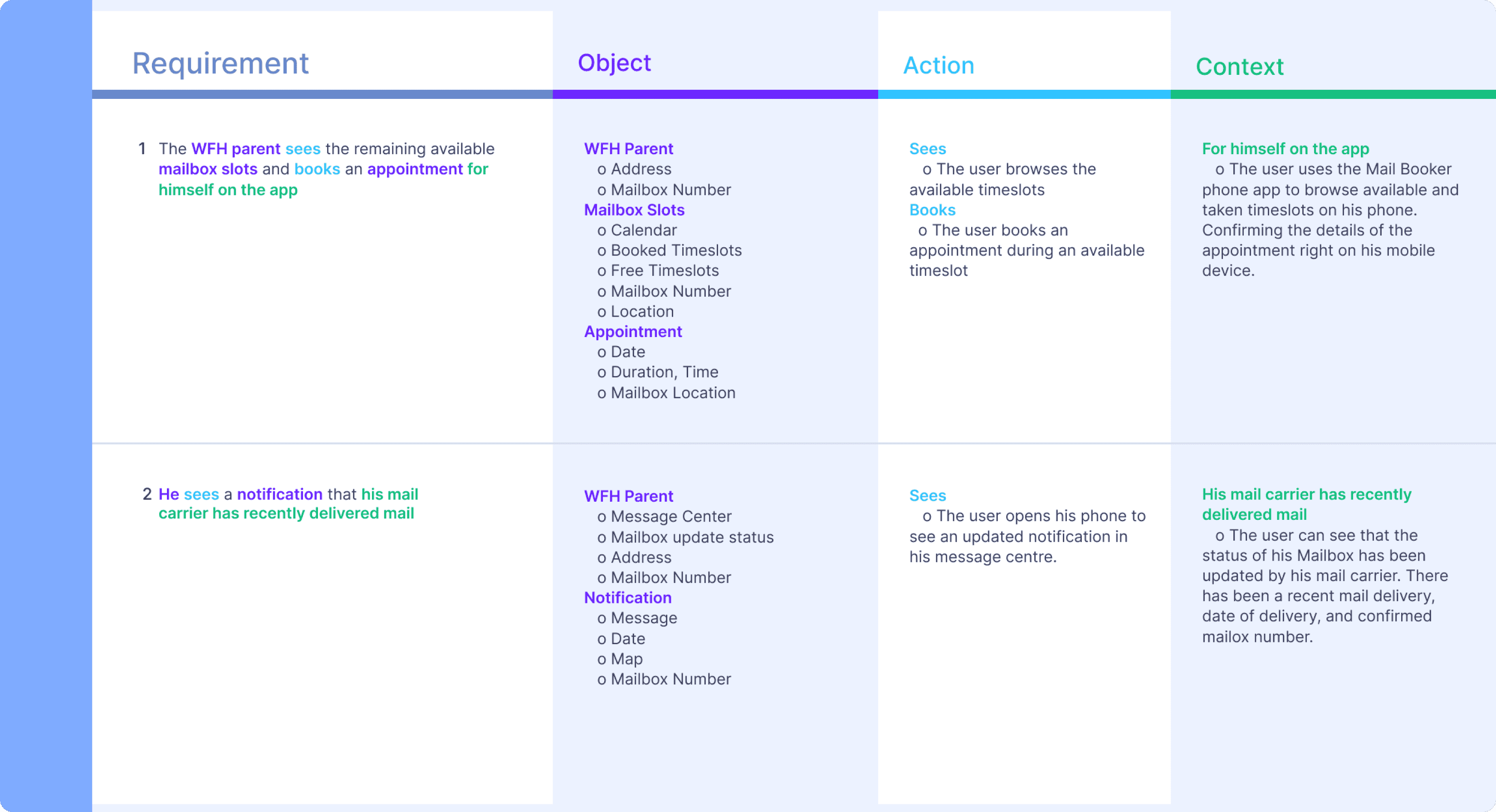
Initial Sketches
Initial sketches helped me visualize the relationship between use pattern and user interactions distilled from the design requirements.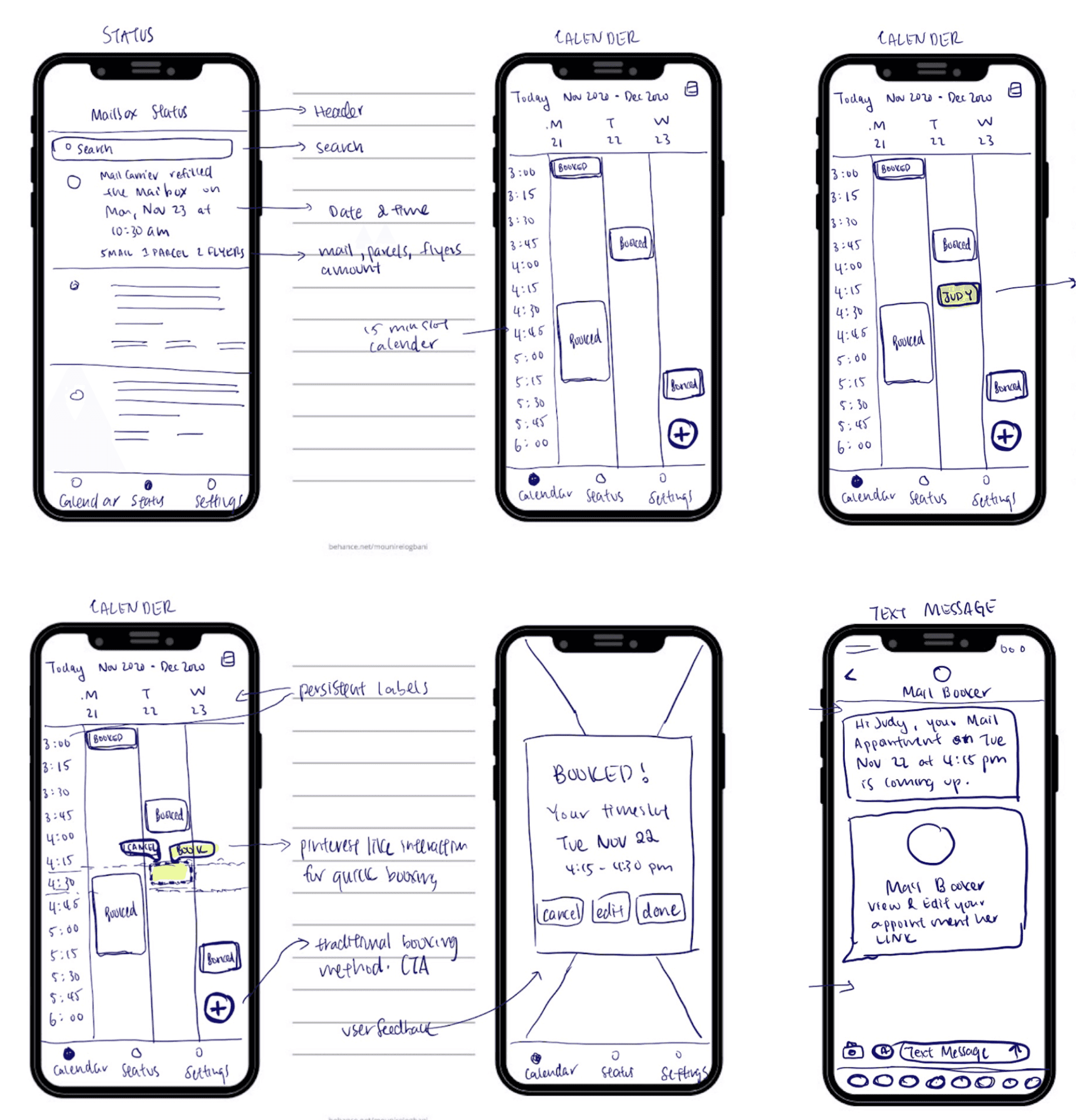
Style Tile
The design system for the intervention. Inspired by Material Design purples, I incorporated elements that fit without making the iOS app look like an Android app.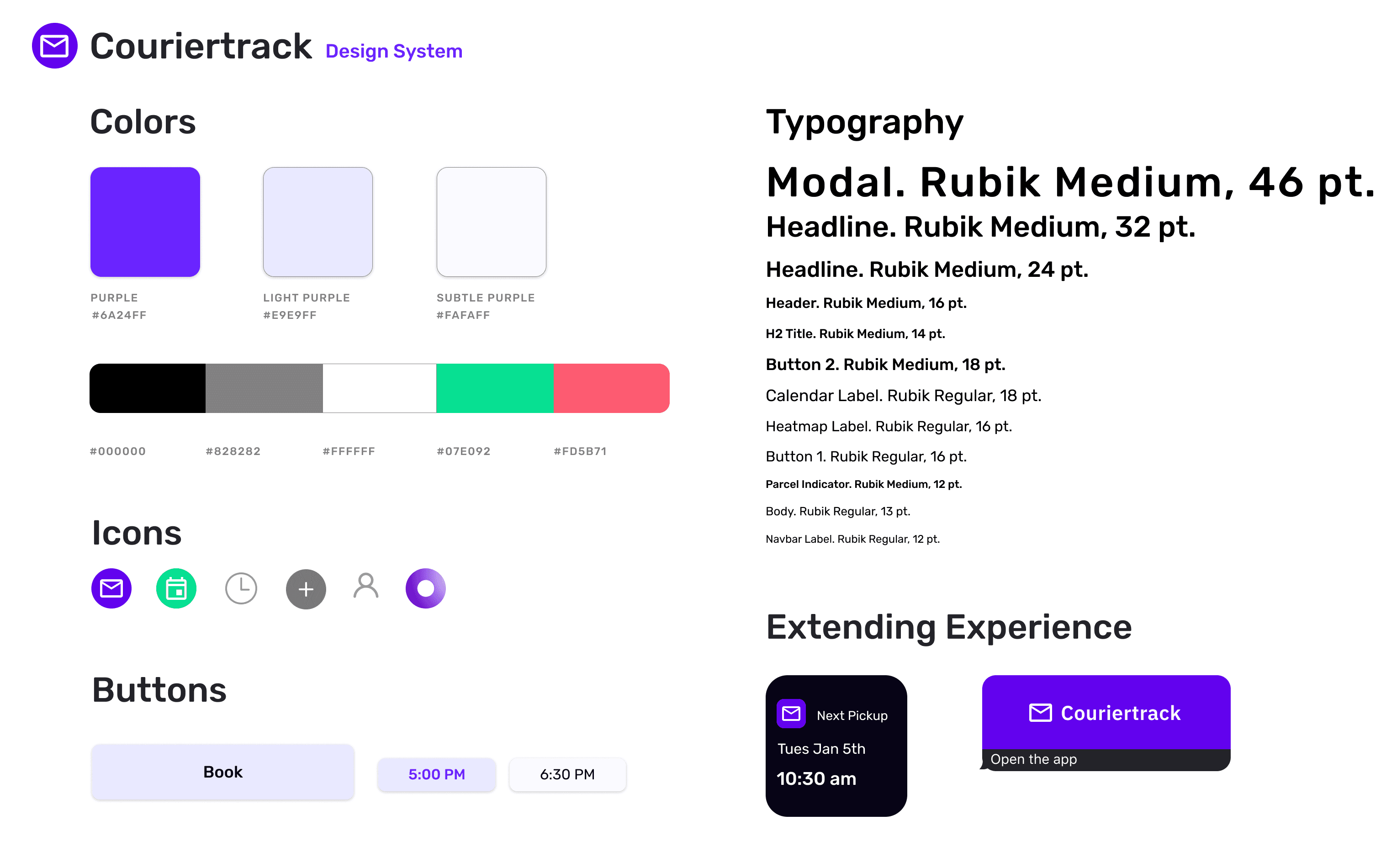
Wireframe Iterations
The wireframes went through many iterations following weekly lectures and critique groups with the professor and peers — refining the prototype screens week by week.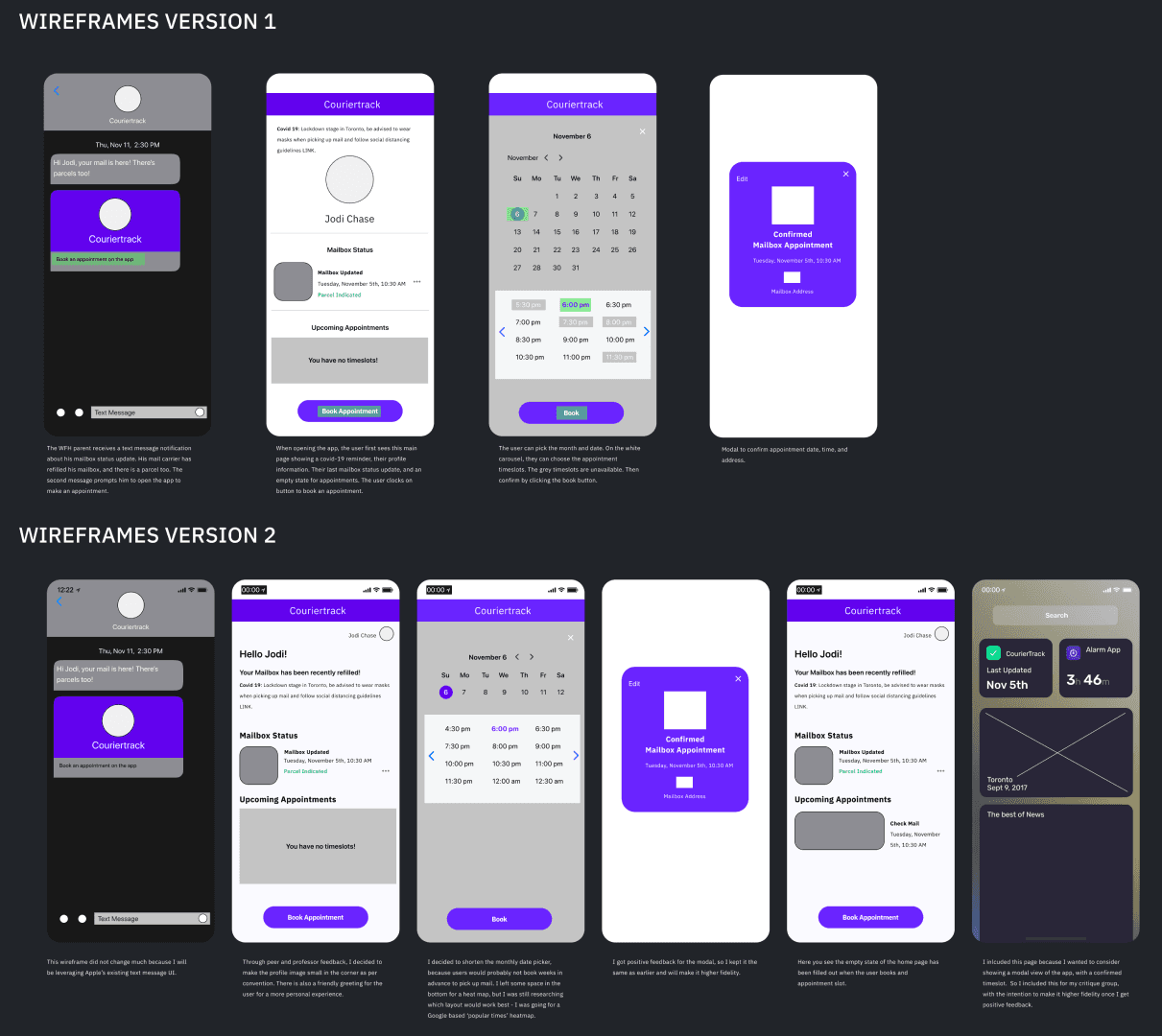
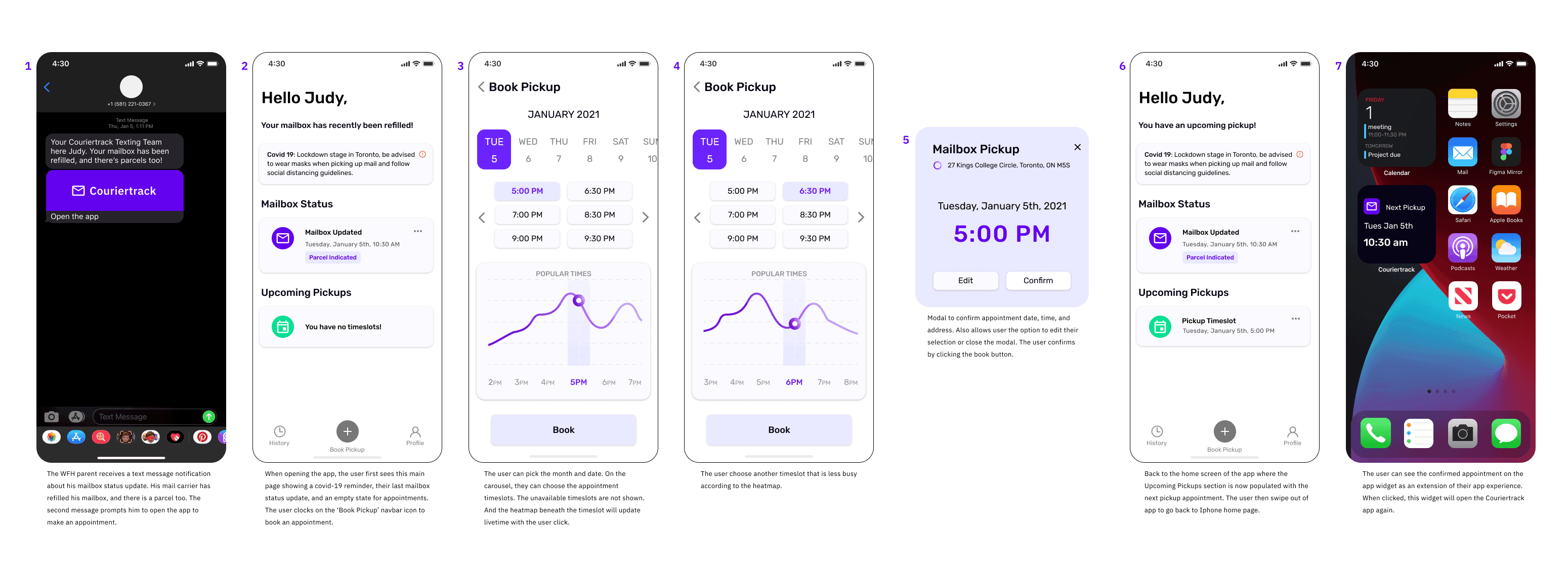
High-Fidelity Storyboard
The Solution
A simple user flow for checking the mailbox and booking an appointment — built on the data and ERAF analysis above.
Reflection
01Key Takeaways- My initial assumption that community parks were relatively safe proved incorrect once examined through observational data — particularly in the context of Canada's second wave of the pandemic.
- Weekly critique sessions were instrumental in helping me refine my thinking and iterate on deliverables with intention and clarity.
- Leveraging secondary data strengthened my understanding of household size and demographics, which directly informed the accuracy and depth of my user persona.
- The hardest part was constructing the ERAF Systems Diagram — the relationships between entities weren't driven by monetary exchange and required careful consideration of exposure-based flows.
- Pandemic constraints limited me to passive observation in public spaces — I couldn't interact with participants directly, which restricted qualitative depth.